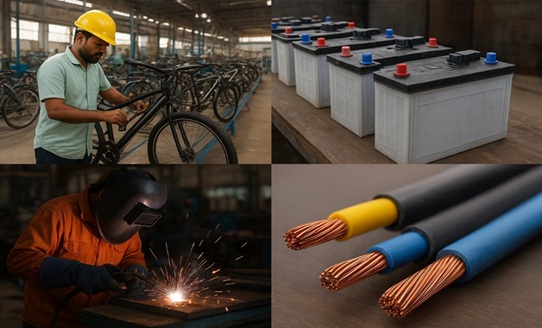
 Source: AI Generated
In the era where emerging economies are vying for global investment, Bangladesh stands out as a promising destination, particularly in its light engineering (LE) sector originating from small workshops, serving local agricultural and industrial needs.Bangladesh's light engineering (LE) sector now produces over 10,000 products, including machinery spares, agricultural and textile machinery, batteries, bicycle components, and electronics, meeting 50% of local demand specially for shipbuilding, railroads, RMG, paper and pulp, pharmaceuticals, automobiles, and construction sectors. This sector also exports to the EU, Australia, Japan, China, and India[1] . BIDA, in its FDI heatmap, included Light engineering sector in the basket of sectors with moderate market readiness but strong competitive advantages, requiring streamlined entry processes for investors.
The industry is pivotal to the country's drive at export diversification and industrialization and contributing around 3% to GDP with a domestic market size of $8.2 billion in 2023–2024 and employing over 1 million skilled workers in 80,000 small and medium-scale enterprises (SMEs)[2] . Key hubs such as Dhaka, Chattogram, Narayanganj, Bogura, Jessore, Gazipur, and Kishoreganj drive specialized manufacturing and economies of scale. This sector, regarded as a High-Priority Sector in the Export Policy (2024–2027), is fueled by supportive government policies, affordable labor, and strong demand. The export of the sector is projected to reach $12.56 billion by 2030[3] .
Figure 1: Top ten Greenfield and Cross-border Merger &Acquisition(M &A) investment sector industries in the world.

Looking into global trend of FDI, the Greenfield investment sector shows strong growth in Information and Communication (73%) and Construction (25%), but struggles with Extractive Industries (-48%) and Energy and Gas Supply (-28%). In contrast, Cross-border M&A thrives in Basic Metal and Metal Products (394%) and Electronics and Electrical Equipment (296%), though it faces declines in Extractive Industries (-47%) and Pharmaceuticals (-17%). Globally, supply chains, renewable energy, and the digital economy drove greenfield investments. Over the last decade, Asia’s digital economy recorded the fastest growth, with project value up 146% and strong inflows from the U.S., Singapore, and China, making it the largest sector by project numbers. Electronics and electrical equipment rose 59% due to rising demand for semiconductors, EV parts, and automation, while metal products grew over 60% in value, shifting toward larger projects. Energy, gas, transportation, and storage also expanded, highlighting[4] Asia’s emergence as a hub for advanced manufacturing, renewable energy, and logistics. Reviewing both greenfield and cross-border M&A investment, it may be observed that the sectors related to LE are experiencing investment growth around the world.
Figure 2: FDI Inflow and Export of Light Engineering Sector of Bangladesh

According to Akter Sumi et al.[5] , a 1% increase in FDI inflows leads to a 0.15% growth in exports in Bangladesh. Looking into FDI in LE sector in the fiscal year (FY) 2023-24, the Metal & Machinery Products sector received FDI of $14.37 million (a 5.47% increase), while the Vehicle & Transport Equipment sector received $3.29 million (a 1.53% decrease)[6] . However, the export of Light Engineering (LE) products (HS Chapter :71-88 & 90) increased from $438 million USD in FY 2017-18 to $617 million USD[7] in FY 2024-25, with a CAGR of 4.4%. However, according to Index of Industrial Production (IIP) of large-scale manufacturing by BBS all subsectors of LE experienced increase in industrial production except Manufacture of Basic metals products. In contrast, IIP of Manufacturing on SMMe Scale all subsectors of LE experienced reduction except Mfg. of computer, electronic and optical, Mfg. of Motor vehicles, trailers and semi-trailers and Mfg. of Other Transport Equipment products[8] .
Figure 3: LE export (%) in the world market and top five products export share in Bangladesh LE exports in 2025 with export destination

In 2024, global trade was dominated by electrical machinery (29.05%) (Figure 3), mechanical appliances (22.35%), and vehicles (14.77%), led by China, Germany, the U.S., and East Asia, reflecting strong technological capacity and advanced manufacturing bases. High-value sectors like precious metals (7.64%) and optical/medical instruments (5.59%) further underscore developed economies’ competitiveness. By contrast, Bangladesh’s light engineering exports in FY 2024–25 remained marginal, accounting for only 1.28% of the country’s total exports, with major destinations including China, Germany, Great Britain, Italy, India, Japan, Turkey, and the United States. Among the subsectors of LE, the electrical machinery and equipment (7.5%) topped the total export of LE, followed by Vehicles others than railway or tramway rolling-stock (4.6%), Toys, games and sports requisites (3.9%), Optical, photographic, cinematographic, instruments and apparatus (3.8%) and Copper and article (2.8%).
Challenges Hindering FDI Growth in Light Engineering Sector
The Light Engineering sector in Bangladesh holds significant potential but struggles to attract foreign direct investment due to structural and macroeconomic constraints. Regulatory complexity, delayed customs clearance, and a partially functional BIDA One-Stop Service raise business costs and delays compared to regional peers[9] . Currently, BIDA’s One-Stop Service covers only 18 organizations and 58 services, compared to the target of 52 organizations and 133 services[10] . High import tariffs 10–25% on raw materials and up to 55% [11] on critical components inflate production costs in industries such as bicycles and cables, undermining competitiveness[12] . Moreover, shortage of skilled labor in engineering and machine operation further limits[13] productivity and export quality. Infrastructural bottlenecks, including unreliable energy supply, weak transport logistics, and port congestion disrupt operations[14] . Technological gaps and insufficient R&D restrict innovation and product diversification[15] . Additionally, macroeconomic challenges such as currency volatility, rising inflation, high interest rates, and a fragile financial sector with large non-performing loans further erode investor confidence[16] . Limited capital market depth and difficulties in profit repatriation also deter FDI inflows.
Strategies for Boosting FDI Growth in Light Engineering Sector
Enhancing FDI in Bangladesh’s Light Engineering (LE) sector requires a multi-faceted approach to address structural, infrastructural, and regulatory challenges. Strengthening International Investment Agreements (IIAs) and bilateral treaties by promoting technology transfer, skills development, and facilitation commitments may reduce entry barriers and enhances regulatory predictability, addressing investor concerns about policy uncertainty[17] . Additionally, streamlining licencing and approval process through BIDA’s One-Stop Service may minimize delays, costs, and regulatory challenges that would boost competitiveness against Vietnam and India. Besides, upgrading infrastructure, energy, and transport in industrial zones, alongside FDI heatmap, promotion of high-growth subsectors like machinery and electronics, may resolve bottlenecks and attracts global investors[18] . Public-private collaboration may align policies with market needs, while regular stakeholder consultations and updated sectoral data improve strategic decision-making process[19] . Moreover, by assessing the potential of LE products based on export opportunities, local market demand, capacity for import substitution, existing FDI inflows, comparative advantages, Bangladesh can streamline investment processes and attract more FDI[20] . Furthermore, enhancing governance, transparency, and investor incentives, including production-linked incentives to reward investors upon achieving job creation, value addition, export growth or technology transfer, fosters investor confidence[21] . By tackling regulatory challenges and ensuring policy clarity, Bangladesh can unlock the LE sector’s $12.56 billion potential by 2030[22] .
Bangladesh's Light Engineering (LE) sector holds immense promise for FDI-driven growth and is a hidden gem for global investors. However, challenges such as bureaucratic hurdles, high import tariffs, skilled labor shortages, infrastructure gaps, and macroeconomic volatility continue to limit investment. Addressing these challenges through streamlined BIDA One-Stop Services, targeted SEZ incentives, robust governance, production-linked rewards, and upgraded industrial infrastructure, Bangladesh can unlock the sector’s full potential. With these reforms, the LE sector offers a high-value, scalable, and export-ready opportunity.
References



-medium.jpg)